

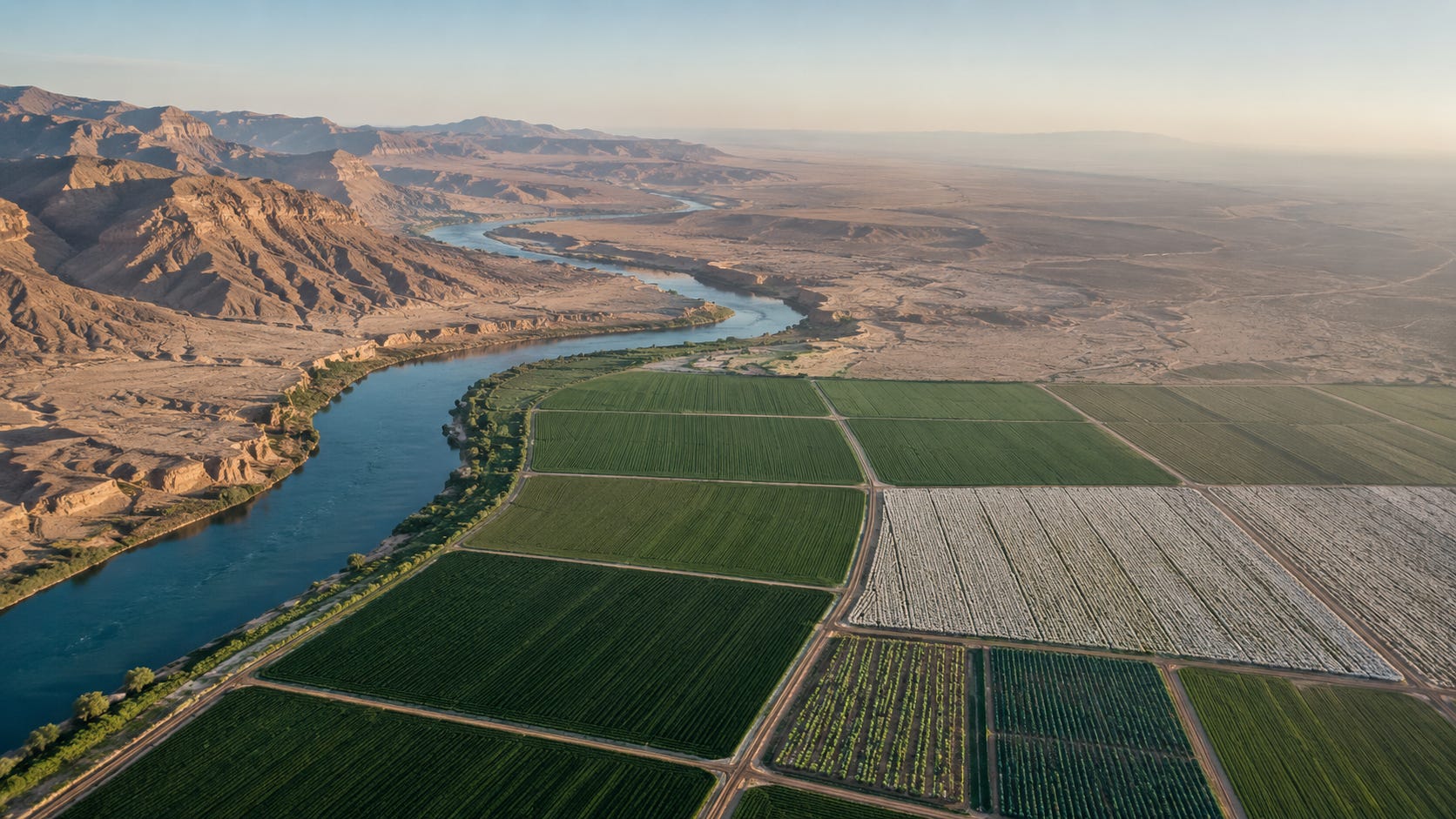
As the seven Colorado River states fight over a shrinking supply, one statistic appears again and again:
The Colorado River irrigates land that produces 15% of America’s food.
It is a powerful number because it seems to settle the argument before it begins. Cut agricultural water, the framing suggests, and America loses a meaningful share of its food supply.
There is just one problem: the statistic does not measure the share of food Americans eat.
And once we follow the water instead of the headline, the policy question changes.
What does “15%” actually measure?
The Bureau of Reclamation’s landmark 2012 basin study said Colorado River water supported land “producing some 15 percent of the nation’s crops and about 13 percent of its livestock.” It did not define that 15% as calories, tonnage or the share of food consumed by Americans.
At a 2013 Senate hearing, Colorado State University water expert Reagan Waskom used a more precise formulation: roughly four million irrigated acres in the Upper and Lower Basins represented about 15% of U.S. crop receipts and 13% of U.S. livestock. This 15% number has come up again 13 years later in a recent USA Today article.
Crop receipts are an economic measure. They are not the same as 15% of the nation’s food supply.
Yet over time, the wording migrated—from crop receipts, to crops, to “food output” in later reporting. Each version sounds close to the one before it. Each carries a different meaning.
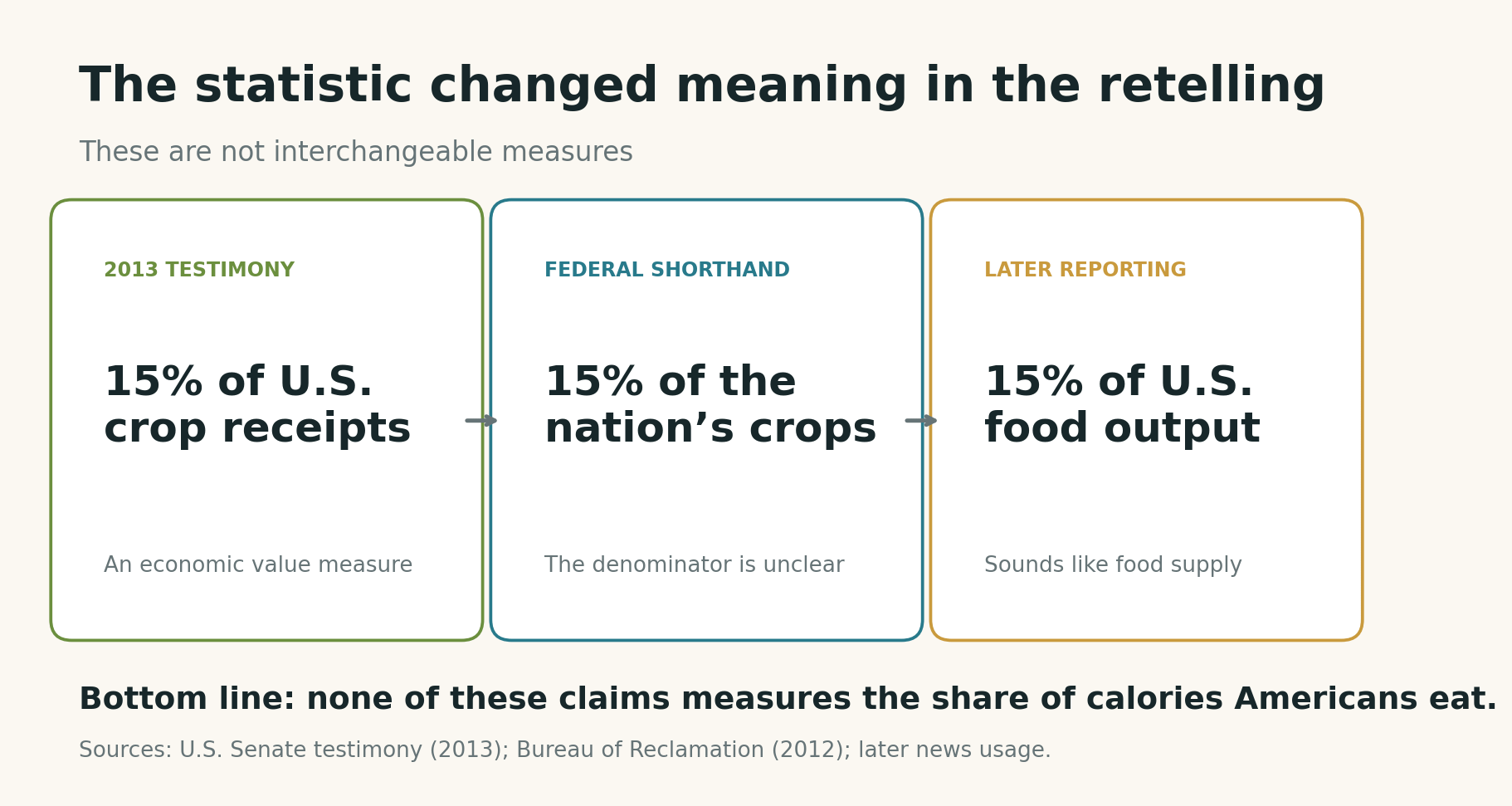
The original statistic may still describe something important about the basin’s agricultural economy. But it cannot tell us how many calories the river produces, what share of the nation’s food would disappear without it, or how replaceable different crops might be.
For those questions, we need to know where the water actually goes.
The river’s largest direct human use is agriculture
A major 2024 study in Communications Earth & Environment reconstructed the basin’s consumptive water use from 2000 through 2019. Unlike a simple tally of withdrawals, consumptive use measures water that is not returned to the river system after use.
The researchers estimated average annual consumption of 19.3 million acre-feet. Agriculture accounted for 52% of that total. Municipal, commercial and industrial uses accounted for 18%. Riparian and wetland vegetation consumed 19%, while reservoir evaporation claimed the remaining 11%.
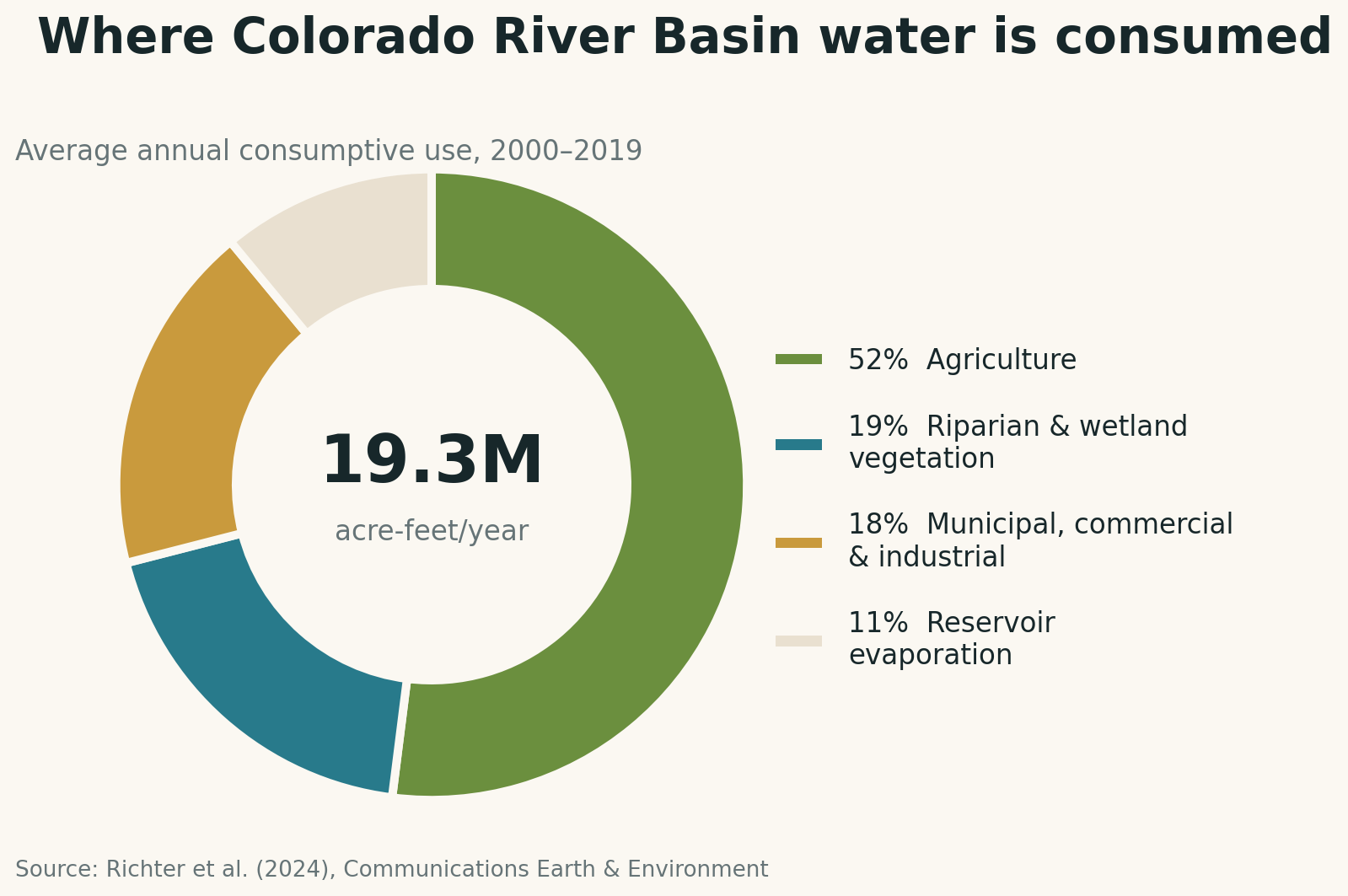
If we look only at direct human uses—agriculture plus municipal, commercial and industrial consumption—agriculture’s share rises to 74%.
Agriculture unquestionably dominates direct human consumption of Colorado River water. But “agriculture” still tells us almost nothing about what the water produces.
The biggest crop category is feed
The 2024 accounting found that 62% of agricultural consumptive use goes to alfalfa and other hay. That is about 32% of all basin consumption and 46% of all direct human consumption.
Put simply: for every 100 gallons consumed by Colorado River agriculture, about 62 gallons grow alfalfa or other hay.
Those crops are predominantly animal feed. They support beef and dairy production, so they are part of the food system—but through an additional conversion step. The river grows feed, which is then converted into meat or dairy.
There is also a limit to what the data can tell us. Researchers classify the category as cattle-feed crops because cattle are the dominant market, but no basin-wide accounting tracks every bale. Some hay feeds horses and other animals kept for work, recreation or companionship.
That is why it would be misleading to label all hay water “non-food.”
Cotton complicates the picture again
The same study attributed roughly 584,000 acre-feet a year to cotton—about 6% of agricultural consumptive use, or approximately 190 billion gallons.
Cotton is grown primarily for fiber, not food. But the plant also produces cottonseed, which can become livestock feed or cottonseed oil. Calling every gallon used by cotton “non-food” would also overstate the evidence.
What we can say is both precise and revealing:
About 68% of agricultural consumptive use is associated with alfalfa and other hay, plus cotton.
The remaining roughly 32% includes vegetables, fruit, grains, nuts and other crops—the products many readers naturally picture when they hear that the river grows “15% of America’s food.”
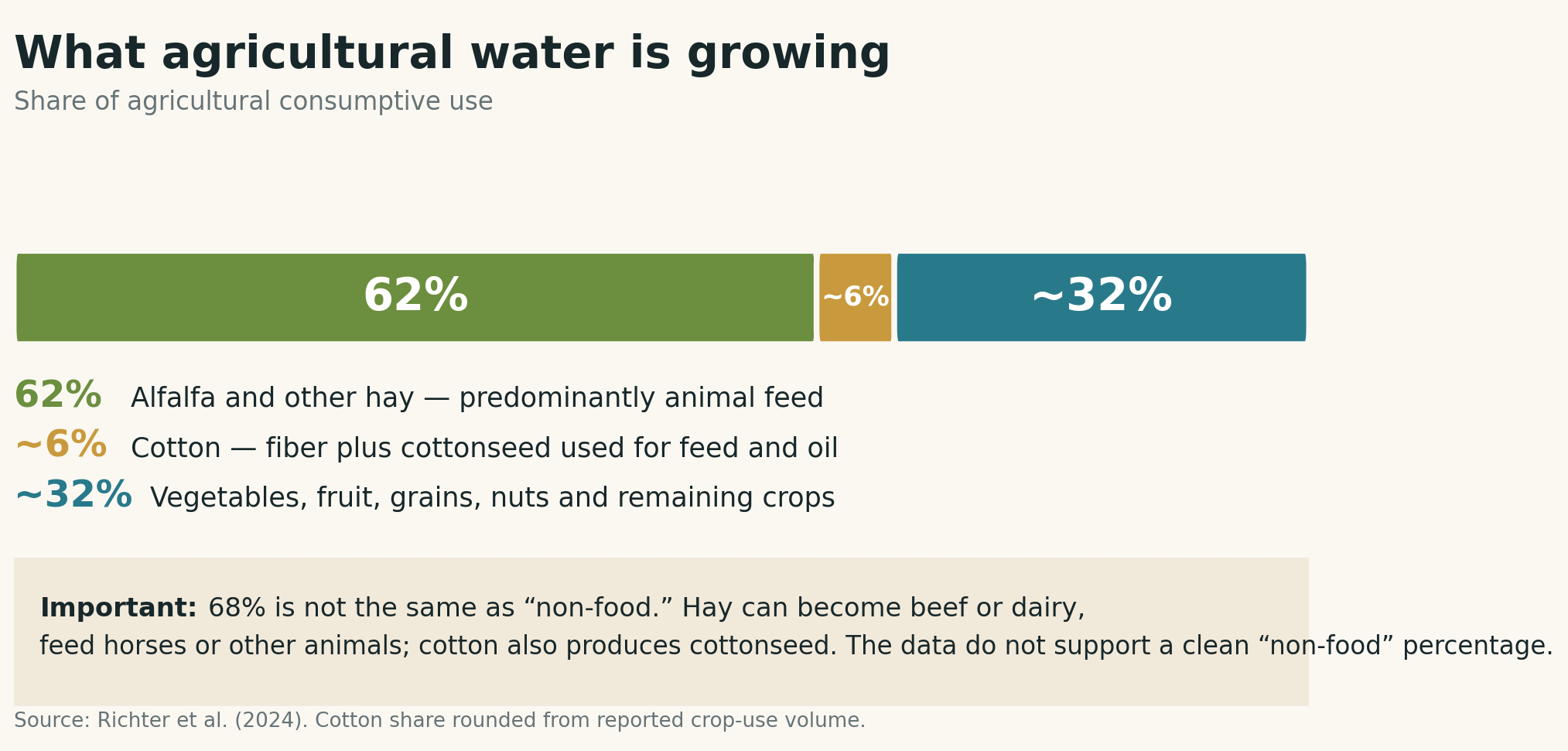
That 68% is not a defensible estimate of “non-food water.” It is a defensible estimate of water associated with two crop categories whose end uses are more complicated than the familiar food-security slogan suggests.
The ambiguity is not a weakness in the analysis. It is the point. Agricultural supply chains do not divide cleanly into FOOD and NOT FOOD, and a serious water policy should not pretend they do.
Do not dismiss the lettuce
Correcting the 15% claim does not make Colorado River agriculture unimportant to the food supply. Some of it is exceptionally important.
Yuma, Arizona, and California’s Imperial Valley offer something the Midwest cannot easily reproduce: a remarkably productive winter growing season. The University of Arizona reports that the Yuma region produces roughly 90% of North American-grown leafy greens during winter.
Those vegetables occupy a much smaller share of the basin’s agricultural water footprint than hay, yet they fill a disproportionately important seasonal niche. An acre-foot used for winter lettuce in Yuma is not economically or strategically identical to an acre-foot used for alfalfa. Neither is identical to an acre-foot used for cotton.
That is precisely why “15% of America’s food” is such an unhelpful shorthand. It combines very different products, values and replacement risks into one impressive but nearly useless number.
The math changes the question
The Colorado River debate is usually framed as farms versus cities. That is too crude.
The better question is:
What does each acre-foot produce, what is that production worth, and how difficult would it be to replace?
Some water produces winter vegetables that would be difficult to replace domestically during that season. Some produces fruit and grain. Some produces cattle feed. Some produces cotton fiber. Some sustains rural and tribal communities where agriculture has cultural, legal and economic significance extending beyond the market price of the crop.
Those distinctions do not produce an easy answer. They produce the right analysis.
The 2024 study cited estimates that stabilizing Lake Mead and Lake Powell could require reducing Upper and Lower Basin consumptive use by 2.4 million to 3.2 million acre-feet a year, with additional reductions potentially needed as warming further reduces runoff.
At that scale, a slogan cannot tell us where the cuts should fall.
We need to know what is grown, how much water it consumes, the value it creates, whether its production can move, and what communities lose if it does.
The Math Doesn’t Lie
The famous 15% statistic is not a measurement of America’s food supply. It is an agricultural production statistic that gradually acquired a broader meaning in public retelling than the underlying evidence can support.
The water accounting tells a more useful story:
Agriculture consumes 74% of direct human use of Colorado River Basin water.
62% of agricultural consumption goes to alfalfa and other hay.
Cotton uses roughly another 6%.
A comparatively small agricultural share produces winter vegetables with outsized seasonal importance.
None of this is an argument to stop farming the Colorado River Basin.
It is an argument that an acre-foot of agricultural water is not an interchangeable unit of food security.
The next Colorado River agreement should not begin with farms versus cities. It should begin with a spreadsheet.
Follow the acre-foot. What did it produce? What was it worth? Could we produce it somewhere else? And what would happen if we did not?
Once every acre-foot matters, those are the numbers that matter too.
A note on AI and this article
AI tools assisted with research organization, arithmetic checks, editing and visual development.. The hero image was generated with AI; the data graphics were created from the cited research.
Read More
Richter et al. (2024): New water accounting reveals why the Colorado River no longer reaches the sea
Bureau of Reclamation: Colorado River Basin Water Supply and Demand Study (2012)
U.S. Senate hearing record (2013): testimony describing “15 percent of all crop receipts”
NASA Landsat: Meat of the Matter—Colorado River Over-Consumed
Colorado River cuts could reach far beyond the West | The Excerpt