

Arizona has already experienced its first significant storms of the season, and forecasters are calling for a wetter-than-normal monsoon.
That’s good news.
But while reading a recent groundwater study, I came across a statistic that completely changed how I think about Arizona’s water future.
Only about 3% of Arizona’s rainfall and snowfall ultimately reaches groundwater aquifers.
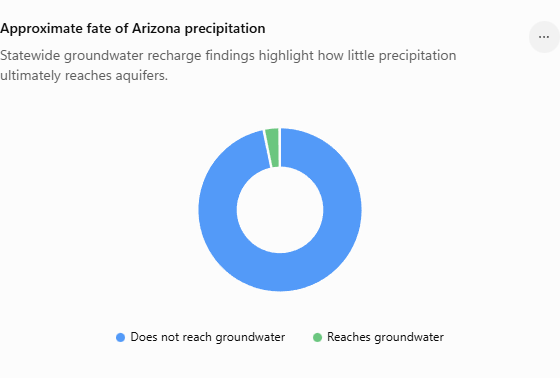
Figure 1. What Happens to Arizona’s Precipitation
That number stopped me.
Like many Arizonans, I’ve always viewed a good monsoon as nature’s way of replenishing our underground water supply. Watching washes flow, seeing the desert turn green, and smelling the creosote after a storm gives the impression that our aquifers are getting a much-needed refill.
The reality appears to be far more complicated.
According to the study, the overwhelming majority of Arizona’s precipitation is consumed by plants, evaporates back into the atmosphere, or otherwise never reaches the groundwater many communities depend on.
That doesn’t mean rain isn’t important.
It means I may have been asking the wrong question.
The Water Balance Sheet
Engineers and accountants often simplify complex systems by thinking in terms of a balance sheet.
Water isn’t much different.
Water Coming In
Annual precipitation
Colorado River imports through the Central Arizona Project (CAP)
Water reuse and recharge projects
Water Going Out
Municipal use
Agriculture and livestock
Industry
Evaporation
Plant consumption
The goal is deceptively simple.
More water needs to enter the system than leave it over the long term.
The Charts Tell an Interesting Story
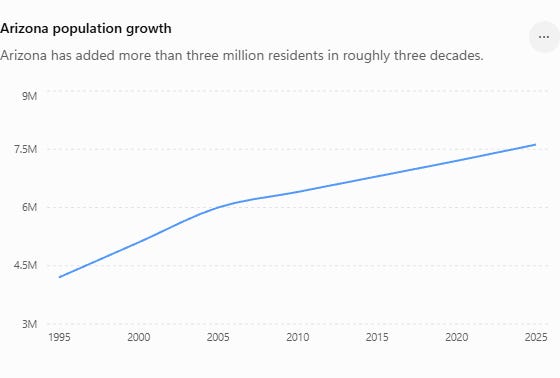
Figure 2. Arizona Population Growth
Arizona has added more than three million residents while continuing to support a major agricultural economy.
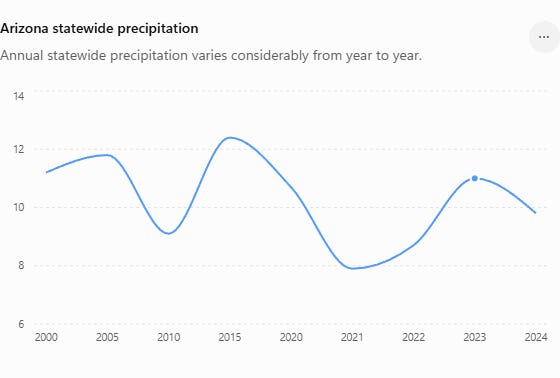
Figure 3. Arizona Statewide Annual Precipitation
Over the past several decades:
Arizona’s annual precipitation has fluctuated dramatically, but there is no obvious straight-line collapse. Arizona has always experienced wet and dry years.
Arizona’s population has grown from roughly 4 million people to more than 7.5 million.
Arizona continues to support a multi-billion-dollar agricultural industry, producing approximately $5.2 billion in agricultural products annually.
Meanwhile...
The Colorado River, the source of Arizona’s Central Arizona Project water, is under increasing long-term pressure.
Water managers already expect future reductions in CAP deliveries.
That’s when the 3% number starts to matter.
Suddenly, CAP Storage Looks Different
For years, Tucson has stored imported Colorado River water underground.
Other parts of Arizona have invested heavily in reservoirs, recharge projects, conservation programs, and long-term water banking.
I’ve always viewed those projects as prudent planning.
After learning that only about 3% of precipitation naturally reaches groundwater aquifers, they look even more important.
If nature is only depositing a small fraction of each year’s precipitation into our underground “savings account,” then every acre-foot successfully stored from the Colorado River becomes significantly more valuable.
The Wrong Debate
Arizona’s water discussions often become debates over:
Agriculture versus cities
Housing versus conservation
Data centers versus farms
Those are important conversations.
But they may distract from the bigger question.
Regardless of who uses the water...
Is more water entering Arizona’s balance sheet than leaving it?
Because eventually, the accounting catches up.
Final Thoughts
I hope this year’s monsoon is a wet one.
Every storm helps.
But after reading this study, I’ll be watching Arizona’s water system a little differently.
Not simply asking:
How much rain did we get?
Instead I’ll be asking:
How much of it actually stayed?
If only about 3% of Arizona’s precipitation ultimately reaches groundwater, and one of our largest imported water supplies is expected to shrink over time…
Is Arizona’s water balance sheet still positive?
That’s the question I’ll be trying to answer in the articles ahead.
Because eventually, the math doesn’t lie.
Sources
Arizona groundwater recharge study (3% recharge finding)
Arizona population estimates
Arizona annual precipitation records
Arizona agricultural production statistics
CAP allocation and Colorado River planning documents